
Global Vision, Local Craftsmanship, Building Partnerships Beyond Borders
Views: 0 Author: Site Editor Publish Time: 2026-07-23 Origin: Site


Placing high-value electronics on unverified or under-rated media consoles introduces severe financial and physical risks. A catastrophic furniture failure can destroy expensive displays, damage vintage equipment, and create serious safety hazards in your living space. Consumers frequently miscalculate the total load of their entertainment setups. Combining large-panel displays, heavy AV receivers, and retro CRT monitors often leads to structural bowing, joint failure, or complete collapse.
To protect your equipment, you must move beyond aesthetic preferences. Evaluating the structural engineering, steel gauge, weld integrity, and manufacturer load ratings of media furniture is essential before making a purchasing decision. Understanding these factors ensures your setup remains secure and functional for years. You need to know exactly what the frame can handle before you load it up with heavy gear.
Baseline Capacities: A standard metal TV stand typically supports 150 to 250 lbs (approx. 68 to 113 kg), while heavy-duty welded steel units can safely hold 250 to 400+ lbs (approx. 113 to 181+ kg). Compact metal stands may only be rated for 44 to 88 lbs (20 to 40 kg).
Construction Matters: Weight capacity is dictated not just by the material, but by the thickness of the steel (gauge), the quality and penetration of structural welds, and the presence of center support legs.
Total Load Calculation: Manufacturer weight limits apply to the entire unit; buyers must calculate the combined weight of the television, internal media components, and enclosed storage items.
Strict Adherence to Ratings: Exceeding stated weight limits—even on seemingly sturdy metal frames—introduces severe tipping hazards, compromises structural integrity, and voids manufacturer warranties.
Consumer-grade metal stands designed for modern flat panels typically support between 150 and 250 lbs (68 to 113 kg). This range easily accommodates most contemporary OLED or LED televisions alongside standard soundbars and streaming devices. When you buy a standard unit, you are getting a frame built for static, evenly distributed loads. Heavy-duty, commercial-grade metal stands push these limits significantly higher. These robust units can safely hold 250 to 400+ lbs (113 to 181+ kg), making them suitable for massive displays or extensive audio-visual equipment racks.
Compact or small metal stands feature lower thresholds, usually rated for 44 to 88 lbs (20 to 40 kg). Setting realistic expectations for entry-level furniture prevents overloading. Manufacturer ratings derive from specific testing conditions. Static load testing measures capacity under balanced, stationary conditions. Dynamic load testing accounts for movement, impact, and shifting weight, providing a more comprehensive view of real-world durability. If you plan to move the unit frequently, you need to pay attention to the dynamic load rating rather than just the static limit.
To properly assess a frame's capability, you should look at the specific testing standards the manufacturer used. A unit tested only for static loads might fail if someone bumps into it or if you slide a heavy receiver across a shelf. Always assume the real-world capacity is slightly lower than the lab-tested maximum to account for uneven floors and off-center weight distribution.
Particle board frequently fails under sustained weight. It sags over time, suffers from fastener pull-out, and loses structural integrity when exposed to moisture. Solid wood offers better strength but requires thick, heavy profiles to achieve high load ratings. Tubular steel possesses superior tensile strength compared to solid hardwood. This allows a metal TV stand to support higher loads while maintaining a slimmer, more modern profile.
Metal also resists environmental factors like humidity and temperature fluctuations. Wood expands and contracts, which can loosen joints over time. Steel maintains consistent load-bearing capabilities over years of use, ensuring your media setup remains perfectly level and secure. When you assemble a wooden stand, you often rely on cam locks and wooden dowels. These hardware pieces shear easily under lateral stress. Steel frames use machine screws tapped directly into the metal or rely on permanent factory welds, offering a much higher shear strength.
Material Type | Typical Load Capacity | Vulnerability | Longevity |
|---|---|---|---|
Particle Board | 50 - 100 lbs | Moisture, fastener pull-out, sagging | Low to Medium |
Solid Wood | 150 - 300 lbs | Humidity expansion, heavy profile | High |
Tubular Steel | 150 - 400+ lbs | Poor weld joints (if cheaply made) | Very High |
MDF (Medium Density Fiberboard) | 80 - 150 lbs | Edge crushing, water damage | Medium |
Steel gauge directly correlates to maximum weight limits. Lower gauge numbers indicate thicker, stronger steel. A 14-gauge steel frame will support significantly more weight than an 18-gauge frame. Frame architecture also plays a critical role. Hollow tubular steel frames offer excellent strength-to-weight ratios, but solid steel reinforcements or structural angle irons provide the ultimate resistance against bending under heavy static loads.
When inspecting a frame, look at the cross-section of the tubing. Square tubing generally resists torsional twisting better than round tubing of the same gauge. If the manufacturer uses thin-walled 20-gauge steel, the stand might feel light and easy to move, but it will buckle under the concentrated weight of a heavy amplifier. You want to see at least 16-gauge steel for any serious home theater application.
Factory-welded joints offer load-bearing superiority over consumer-assembled bolt-together frames. Continuous welds fuse the metal, creating a single structural piece. Poor or uneven weld penetration acts as a primary failure point, drastically reducing effective capacity. Flat-pack metal furniture relies on mechanical fasteners. Common weak points include shearing forces on bolts and stripped threading during assembly, which compromise the unit's overall stability.
Inspect all visible welds for consistency. A good weld looks like a stack of dimes and has no visible cracks or porosity.
Check the hardware provided with flat-pack units. Grade 8 bolts offer much higher tensile strength than cheap, unmarked hardware.
Ensure all threaded inserts are seated flush against the metal tubing. Crooked inserts will strip when you apply torque.
Use a torque wrench if the manufacturer provides specific torque settings for the assembly bolts. Over-tightening can crush thin-walled steel tubing.
Span length impacts structural deflection. Stands over 60 to 70 inches wide are prone to sagging if unsupported. Mid-span center support legs are non-negotiable for wider setups to prevent the top plate from bowing. Load distribution varies based on television design. Center-pedestal TVs concentrate weight directly in the middle, risking localized bowing. Wide-legged TVs distribute weight to the outer edges, transferring the load directly down the vertical frame supports.
Base design also affects stability. Caster wheels offer mobility but concentrate weight on tiny contact points. Adjustable leveling feet or flat sled bases distribute weight more evenly and protect flooring while ensuring the stand remains perfectly horizontal. If you have an uneven floor, a rigid steel frame will wobble. You must use the leveling feet to ensure all points of contact bear the load equally. If one leg is off the ground, the entire weight shifts to the remaining legs, potentially exceeding their individual load ratings.
Calculating the hidden weight of AV equipment is vital. Heavy-duty AV receivers often weigh 25 to 40 lbs alone. Amplifiers, gaming consoles, and premium soundbars add up quickly. Weight must be distributed vertically. Keep heavier items on the bottom shelves to maintain a low center of gravity. This prevents top-heaviness and reduces tipping hazards.
You need to create a spreadsheet or a simple list of every component going onto the stand. Look up the exact weight of your television, your receiver, your center channel speaker, and any gaming consoles. Add 10 pounds for cables and power strips. People often forget that heavy-gauge copper speaker wire and thick power cables add measurable weight to the back of the unit.
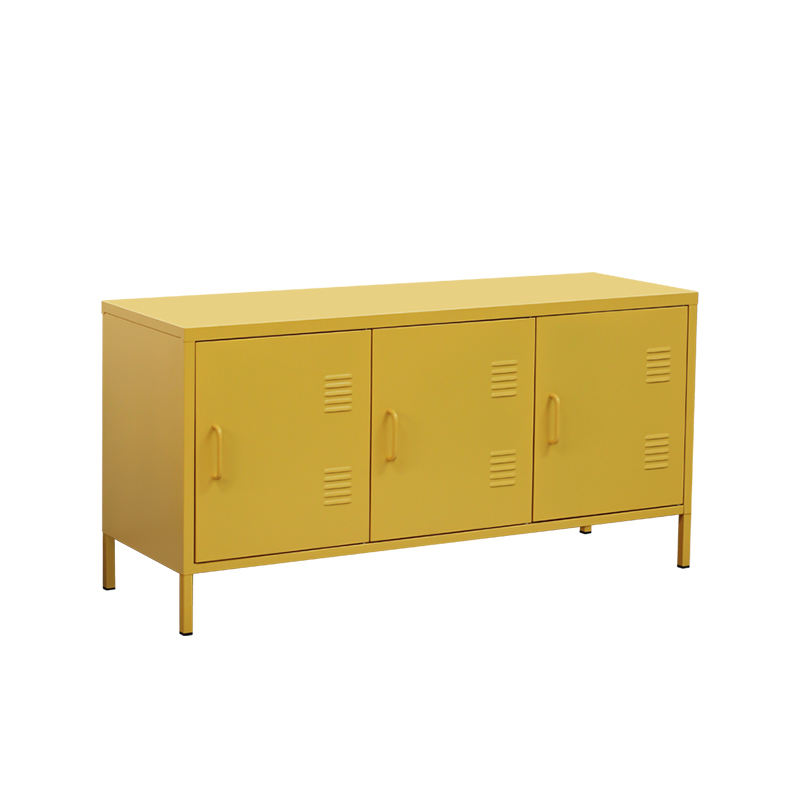
Repurposing a durable steel accent cabinet as a primary media console is a viable strategy for heavy setups. These cabinets often feature reinforced top plates designed for substantial static loads. Evaluate the load limits of the internal metal shelving carefully. While the top may hold a heavy display, adjustable internal shelves might require additional reinforcement to support dense amplifiers.
When using an accent cabinet, check how the internal shelves mount to the side walls. If they rely on small metal pegs, those pegs become the failure point. You might need to swap out standard shelf clips for heavy-duty steel brackets if you plan to load the shelf with a 50-pound vintage amplifier. The outer shell of the cabinet might be rated for 300 pounds, but an individual shelf might only hold 40 pounds.
Utilizing large capacity enclosed storage affects the overall static load on the cabinet's legs and frame. Storing heavy physical media like vinyl records, books, or board games inside the unit adds massive density. You must factor this internal weight into the manufacturer's total load rating to ensure the frame can support both the internal contents and the heavy TV on top.
Vinyl records are incredibly heavy. A standard 12-inch cube filled with records weighs roughly 35 pounds. If you fill the bottom of an enclosed storage unit with four cubes of records, you just added 140 pounds to the frame. If the stand is rated for 200 pounds total, you only have 60 pounds left for the television and the receiver. Always calculate the media weight before you buy the furniture.
Retro gaming setups present unique challenges. CRT televisions possess a drastically different weight-to-footprint ratio than modern OLED panels. A 36-inch Sony Trinitron can weigh approximately 216 lbs (98 kg), concentrated in a very small, deep footprint. This requires specific structural requirements to prevent localized denting or bowing of the metal top plate. Cross-bracing directly under the CRT footprint is often necessary.
You cannot place a 200-pound CRT on a thin sheet metal top without reinforcement. The metal will oil-can, denting inward and permanently deforming. You need a stand with tubular steel cross-members running directly beneath the surface where the TV sits. If the stand lacks this, you can cut a piece of 3/4-inch plywood to match the top dimensions, painting it black to blend in, which will distribute the CRT's footprint across the entire steel frame.
A versatile home locker cabinet offers excellent structural integrity for housing heavy gaming hardware, retro displays, and accessories. The rigid box construction of locker-style storage resists lateral sway. However, active electronics generate heat. You must consider ventilation modifications, cooling fans, and cable management when using enclosed metal storage for running consoles and receivers.
Metal lockers trap heat efficiently. If you put a modern gaming console or a high-current receiver inside a steel locker, it will overheat and shut down. You need to use a hole saw to cut exhaust ports in the back panel and install USB-powered cooling fans. The steel construction makes cutting these holes difficult, so you need proper bi-metal hole saws and cutting fluid to modify the cabinet safely without warping the back panel.
Establish a best practice of keeping your total equipment weight at least 20% below the manufacturer’s maximum stated capacity. This buffer protects against material fatigue. Dynamic loads introduce severe risks. Leaning on the stand, children pulling on edges, or accidental bumps multiply the force exerted on the frame. When a stand is already at maximum static capacity, these dynamic forces can trigger immediate structural failure.
If a stand is rated for 200 pounds, do not load it past 160 pounds. This 40-pound buffer accounts for the times you lean on the edge to plug in an HDMI cable or when a heavy pet jumps onto the top shelf. Metal fatigue happens slowly over time. A frame loaded to 100% capacity might hold up for a year, but the constant stress on the welds and bolts will eventually cause the steel to yield.
Even the heaviest steel frames require anti-tip anchors if you live in earthquake zones or have small children. Securing the furniture to wall studs mitigates the risk of top-heavy setups tipping forward. Always verify that the floor beneath the stand can handle the concentrated point loads of the feet, especially on older wooden subfloors.
Use heavy-duty steel cables or nylon straps bolted directly into a wooden wall stud. Do not use drywall anchors for anti-tip hardware. A 150-pound stand loaded with 100 pounds of gear will rip a drywall anchor straight out of the wall if it starts to tip. Drill a pilot hole into the stud and use a 2-inch lag screw to secure the strap.
Calculate the exact combined weight of your television, AV receiver, consoles, and stored media before purchasing a stand.
Inspect the steel gauge and verify the presence of center support legs for any console wider than 60 inches.
Apply the 20% safety margin rule to ensure dynamic forces do not compromise the structural integrity of your setup.
Install anti-tip hardware to secure heavy metal furniture directly to wall studs.
A: Manufacturers usually list the steel gauge in the technical specifications. Lower numbers mean thicker steel. If it is not listed, check the overall weight of the unassembled unit; heavier shipping weights generally indicate thicker, higher-quality steel.
A: No. Exceeding the manufacturer's weight rating compromises the structural integrity, risks catastrophic failure, creates tipping hazards, and immediately voids your warranty.
A: Sagging occurs when the span length is too wide for the steel gauge without adequate support. Ensure your stand has a mid-span center support leg installed and adjusted firmly against the floor.
A: Casters concentrate massive weight onto small contact points. They are safe only if the manufacturer specifically rates the casters for the total dynamic load. Otherwise, use flat sled bases or leveling feet.
A: Yes. The manufacturer's maximum weight capacity applies to the entire unit. You must combine the weight of the TV, top-shelf items, and all items stored inside the cabinets or drawers.


